Most machine shops that successfully break into aerospace don’t do it overnight — and the ones that try to skip steps usually pay for it with failed audits, scrapped parts, and frustrated customers. The transition from general industrial machining to aerospace is less about buying new equipment and more about building a completely different operating discipline.
Here’s what that actually looks like in practice.
What Separates Aerospace Machining from General Manufacturing
The core difference isn’t tolerances — it’s traceability. A general job shop can produce a ±0.01 mm part and move on. An aerospace supplier produces that same part and then documents who touched it, what cutting tool was used, its batch number, the coolant temperature, the operator’s certification level, and the inspection results at each stage.
Aerospace OEMs and Tier 1 suppliers operate under strict regulations from bodies like FAA, EASA, and DCSA. Every component that flies is subject to airworthiness requirements that trace back to the material heat lot and forward to the final assembly record. If you can’t prove what you made, you didn’t make it — at least not for aerospace purposes.
The second major shift is material complexity. Aerospace components are predominantly machined from titanium alloys (Ti-6Al-4V being the workhorse), nickel superalloys like Inconel 718, aluminum aerospace grades (7075, 2024), and carbon fiber composites. These materials behave nothing like structural steel: they work-harden, generate extreme cutting forces, and demand rigorous chip evacuation. Shops that underestimate this usually discover it through spindle crashes and scrap rates that kill margins.
AS9100 and NADCAP: What Certification Actually Costs
AS9100 is the aerospace quality management standard built on ISO 9001 with aviation-specific additions. It covers risk management, configuration control, first article inspection (FAI), and supplier control — none of which are optional.
Getting AS9100 certified typically involves:
- A 12–18 month preparation period (for a shop with an existing ISO 9001 foundation)
- Hiring or training an internal quality manager with aerospace QMS experience
- Registration body audit fees: roughly $5,000–$12,000 for the initial certification
- Total internal cost (staff hours, process documentation, system upgrades): commonly $40,000–$120,000 depending on facility size
NADCAP (National Aerospace and Defense Contractors Accreditation Program) is separate and applies to special processes: heat treatment, chemical processing, welding, non-destructive testing (NDT), and others. If your shop performs any of these in-house, NADCAP accreditation will be required by most major customers. Each commodity is audited individually; a shop seeking accreditation in both NDT and chemical processing is looking at two separate audit cycles.
“NADCAP wasn’t optional for us — the moment we quoted to a Tier 1 supplier for treated aluminum structural parts, it was the first question on their supplier qualification form.” — Manufacturing director, 85-person job shop
The key point: certification is a revenue prerequisite, not a differentiator. No AS9100 = no RFQs from serious aerospace customers. Period.
Precision, Materials, and Documentation Standards
Typical aerospace dimensional requirements push into the ±0.005 mm range for critical features, with some bearing bores and turbine component interfaces holding ±0.002 mm or tighter. Surface roughness requirements are often Ra 0.4–0.8 µm for sealing surfaces. These aren’t impossible to achieve — but they require temperature-controlled inspection rooms, calibrated CMMs (coordinate measuring machines), and trained metrology staff.
Material traceability means maintaining a chain of documentation from the raw material mill certificate through every transformation to the finished part. The First Article Inspection Report (FAIR) per AS9102 captures 100% of all design requirements for the first production unit. This is not a quality check — it’s a contractual deliverable.
Process documentation includes:
- Control plans for each operation
- FMEAs (Failure Mode and Effects Analysis) for critical characteristics
- Calibration records for every piece of inspection equipment
- Operator qualification and training records
Miss any of these and you’ll fail an audit or a customer source inspection.
Equipment and Software You Actually Need
Five-axis machining capability is essentially non-negotiable for structural aerospace components. Complex contoured surfaces — ribs, spars, impeller blades, housings — cannot be efficiently produced on 3-axis equipment without multiple setups that introduce fixturing errors. A high-rigidity 5-axis machining center from a manufacturer like DMG Mori, Makino, or Hermle, capable of maintaining position accuracy under thermal load, is the baseline.
Beyond the machine itself, the CAM programming environment is where aerospace quality is either built in or lost. Aerospace toolpaths for titanium and Inconel require careful management of chip thinning, trochoidal milling strategies, and constant chip load — mistakes here don’t just produce bad parts, they destroy tooling and spindles.
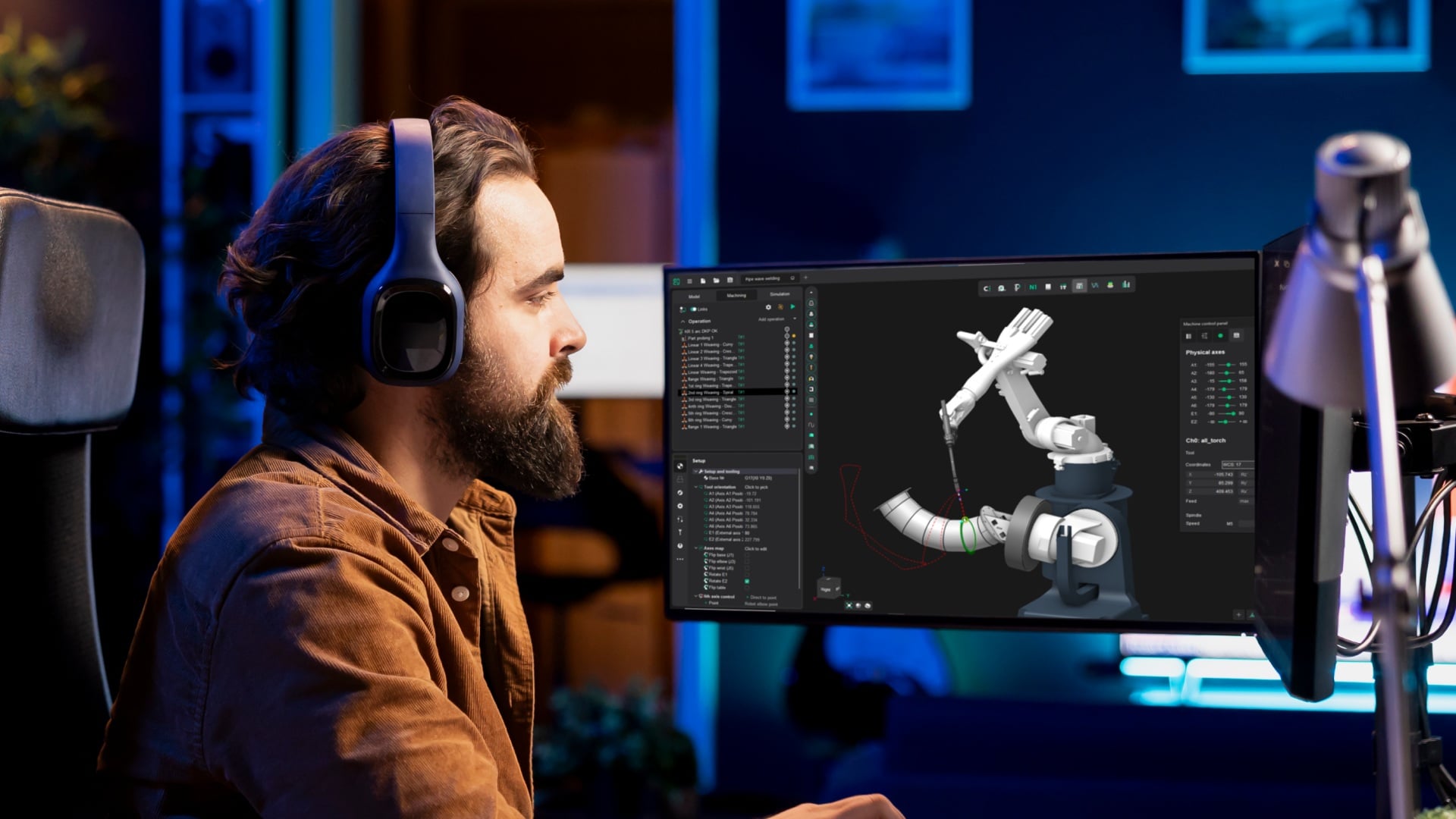
For shops looking to build this capability, Encycam.com is a CAD/CAM system built specifically for complex multi-axis machining, with dedicated 5-axis strategies, high-fidelity machine simulation, and support for difficult aerospace materials. The simulation environment allows programmers to verify toolpaths against the full machine kinematics before a single chip is cut — which matters enormously when you’re running a $4,000 titanium billet.
Other software requirements include a shop-floor capable ERP/MRP system with traceability modules, CMM measurement software (PC-DMIS, Calypso, or equivalent), and ideally an integrated MES (Manufacturing Execution System) for real-time shop floor data capture.
Real Cases: Small Shops That Made It In
Case 1 — 45-person shop, structural aluminum components. A precision shop spent 14 months achieving AS9100 Rev D certification before landing their first aerospace subcontract — machined aluminum brackets for a regional aircraft program. Year one revenue from aerospace: $380,000. By year three, aerospace represented 40% of their total revenue and had forced them to add a second CMM and upgrade their ERP system.
Case 2 — 28-person shop, titanium turning and milling. A smaller operation targeted medical and automotive first, then used their existing ISO 13485 process discipline as the foundation for AS9100. The transition took 10 months. Their entry point was low-volume, high-mix titanium implant-adjacent components for a defense subcontractor. The work wasn’t glamorous — mostly brackets and fastener plates — but it established the audit trail and quality records that led to more complex work within 18 months.
What both have in common: Neither tried to compete on price. They competed on capability documentation — being able to show, from day one, that their quality system was already speaking the right language.
The Realistic Timeline
For a mid-size shop with existing quality infrastructure, a realistic entry roadmap looks like this:
|
Phase |
Duration |
Key Milestones |
|
Gap analysis + QMS development |
3–6 months |
AS9100 manual, process maps, FMEA templates |
|
Equipment and software readiness |
3–6 months (parallel) |
5-axis capability verified, CMM calibrated, CAM environment validated |
|
AS9100 certification audit |
1–2 months |
Registration body audit, corrective actions |
|
Customer qualification |
3–12 months |
Supplier surveys, FAI submissions, first purchase orders |
Total: 12–24 months from decision to first aerospace revenue.
The companies that succeed don’t treat this as a compliance exercise. They approach it as building a second, more demanding version of their business — one that rewards precision, documentation, and consistency with premium pricing and long-term contracts that general commercial work rarely provides.